
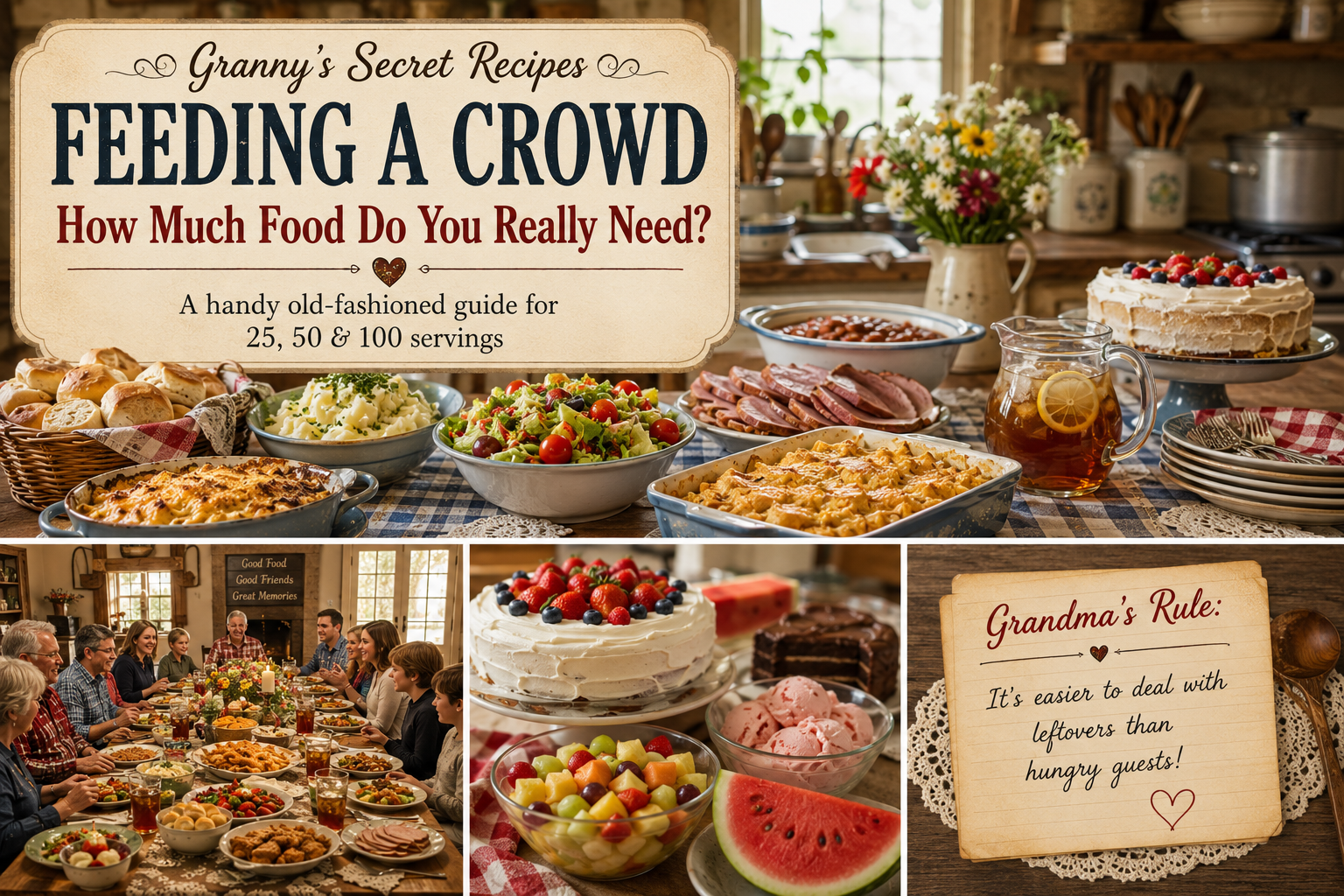
Feeding a Crowd: How Much Food Do You Really Need?
Planning a family reunion, church supper, wedding, graduation party, or neighborhood get-together?
One of the hardest parts of cooking for a crowd isn’t deciding what to make—it’s figuring out how much food you’ll need.
Long before online calculators and catering apps, cooks kept handy charts in their cookbooks that helped them estimate quantities for large gatherings. We’ve taken one of those old-fashioned guides and organized it into an easy-to-use reference for 25, 50, or 100 servings.
So before you start peeling 50 pounds of potatoes, take a look!
Sandwiches & Everyday Foods
| Food | 25 Servings | 50 Servings | 100 Servings |
|---|---|---|---|
| Rolls | 4 dozen | 8 dozen | 16 dozen |
| Bread | 50 slices or 3 one-pound loaves | 100 slices or 6 one-pound loaves | 200 slices or 12 one-pound loaves |
| Butter | ½ pound | ¾–1 pound | 1½ pounds |
| Mayonnaise | 1 cup | 2–3 cups | 4–6 cups |
| Meat, egg, or fish sandwich filling | 1½ quarts | 2½–3 quarts | 5–6 quarts |
| Sweet-fruit sandwich filling | 1 quart | 1¾–2 quarts | 2½–4 quarts |
| Jams & preserves | 1½ pounds | 3 pounds | 6 pounds |
| Crackers | 1½ pounds | 3 pounds | 6 pounds |
| Cheese, 2 oz. per serving | 3 pounds | 6 pounds | 12 pounds |
| Soup | 1½ gallons | 3 gallons | 6 gallons |
| Salad dressing | 1 pint | 2½ pints | ½ gallon |
Meat, Poultry & Fish
This is where knowing your crowd becomes especially important. Are you serving one main dish, or will there be several choices?
| Food | 25 Servings | 50 Servings | 100 Servings |
|---|---|---|---|
| Beef wieners | 6½ pounds | 13 pounds | 25 pounds |
| Hamburger | 9 pounds | 18 pounds | 35 pounds |
| Turkey or chicken | 13 pounds | 25–35 pounds | 50–75 pounds |
| Large whole fish | 13 pounds | 25 pounds | 50 pounds |
| Fish fillets or steaks | 7½ pounds | 15 pounds | 30 pounds |
A little common sense goes a long way
These are planning estimates, not hard-and-fast rules. A meal with several side dishes requires less meat than a meal where the meat is the main attraction.
And when you’re cooking for a crowd, it’s always better to have a little extra than to run out halfway through dinner.
Salads, Casseroles & Vegetables
Some of the best crowd-feeding foods are the ones Grandma knew how to make in big batches.
Potato salad, baked beans, scalloped potatoes, mashed potatoes and spaghetti are all excellent choices because they can be prepared ahead of time and served to a large group.
| Food | 25 Servings | 50 Servings | 100 Servings |
|---|---|---|---|
| Potato salad | 4¼ quarts | 2¼ gallons | 4½ gallons |
| Scalloped potatoes | 4½ quarts or one 12×20-inch pan | 8½ quarts | 17 quarts |
| Mashed potatoes | 9 pounds | 18–20 pounds | 25–35 pounds |
| Spaghetti | 1¼ gallons | 2½ gallons | 5 gallons |
| Baked beans | ¾ gallon | 1¼ gallons | 2½ gallons |
| Jell-O salad | ¾ gallon | 1¼ gallons | 2½ gallons |
| Canned vegetables | 1 #10 can | 2½ #10 cans | 4 #10 cans |
If you’ve never worked with old-fashioned large institutional cans, a #10 can is the large food-service can commonly used by restaurants, schools and organizations.
You may still see them at restaurant-supply stores and warehouse clubs.
Fresh Vegetables
Fresh vegetables can be a little harder to estimate because size varies so much.
| Food | 25 Servings | 50 Servings | 100 Servings |
|---|---|---|---|
| Lettuce for salads | 4 heads | 8 heads | 15 heads |
| Carrots | 6¼ pounds | 12½ pounds | 25 pounds |
| Tomatoes | 3–5 pounds | 7–10 pounds | 14–20 pounds |
Tip from the kitchen: If you’re making a salad for a large gathering, keep the dressing separate whenever possible. It helps prevent the salad from becoming soggy if people are eating over an extended period.
Desserts
And of course, no big family gathering is complete without dessert!
| Dessert | 25 Servings | 50 Servings | 100 Servings |
|---|---|---|---|
| Watermelon | 37½ pounds | 75 pounds | 150 pounds |
| Fruit cup, ½ cup per serving | 3 quarts | 6 quarts | 12 quarts |
| Sheet cake | One 10×12-inch sheet | One 12×20-inch sheet | Two 12×20-inch sheets |
| 10-inch layer cake | 1½ cakes | 3 cakes | 6 cakes |
| Whipping cream | ¾ pint | 1½–2 pints | 3 pints |
Don’t forget the ice cream!
| Ice Cream | 25 Servings | 50 Servings | 100 Servings |
|---|---|---|---|
| Brick ice cream | 3¾ quarts | 6½ quarts | 12½ quarts |
| Bulk ice cream | 2¼ quarts | 4½ quarts or 1¼ gallons | 9 quarts or 2½ gallons |
Beverages for a Crowd
Drinks are one of the easiest things to overlook when you’re planning a large meal.
| Beverage | 25 Servings | 50 Servings | 100 Servings |
|---|---|---|---|
| Coffee | ½ lb. coffee + 1½ gal. water | 1 lb. coffee + 3 gal. water | 2 lbs. coffee + 6 gal. water |
| Tea | ¹⁄₁₂ lb. tea + 1½ gal. water | ⅙ lb. tea + 3 gal. water | ⅓ lb. tea + 6 gal. water |
| Lemonade | 10–15 lemons + 1½ gal. water | 20–30 lemons + 3 gal. water | 40–60 lemons + 6 gal. water |
Grandma’s Rule for Feeding a Crowd
There is one thing that old-fashioned cooking charts can’t tell you:
Know your guests.
Twenty-five people at a family picnic don’t necessarily eat the same amount as twenty-five people at a formal dinner.
If you’re serving several meats, vegetables, salads, desserts and appetizers, people will take smaller portions of each. If you’re serving one main dish with just a couple of sides, you’ll need more of the main dish And remember:
“It’s easier to deal with leftovers than hungry guests.“
When you’re cooking for a big family gathering, don’t be afraid to round your quantities up a little—especially for popular dishes.
A Simple Way to Think About It
If you’re starting with a recipe that serves 25:
25 servings → your original amount
50 servings → roughly double
100 servings → roughly four times
But don’t assume every ingredient should always be multiplied exactly. Large-batch cooking sometimes requires adjustments, particularly with seasonings, liquids, thickening agents, and baking recipes.
That’s one reason old community cookbooks and church cookbooks were so valuable. They contained the experience of people who had already cooked for a crowd.Before everything was measured by an app, Grandma had a cookbook, a pencil, a big mixing bowl—and usually someone standing nearby asking:
“How many people are coming?”
These old kitchen guides are more than measurements. They’re a little piece of cooking history.
They remind us of church suppers, family reunions, holiday dinners, weddings, picnics and those times when somebody said:
“We’d better make enough. You know how this family eats!”
And somehow, Grandma always did.