
Kitchen Math: Understanding Baking Pan Sizes & Capacities
What do you do when a recipe calls for a pan you don’t have? Before you give up on the recipe, check your kitchen cabinets. Chances are, you have another pan that will work.
Baking pans aren’t all created equal. Their diameter, length, width, and depth determine how much batter they hold and, just as importantly, how thick your finished cake, casserole, or dessert will be.
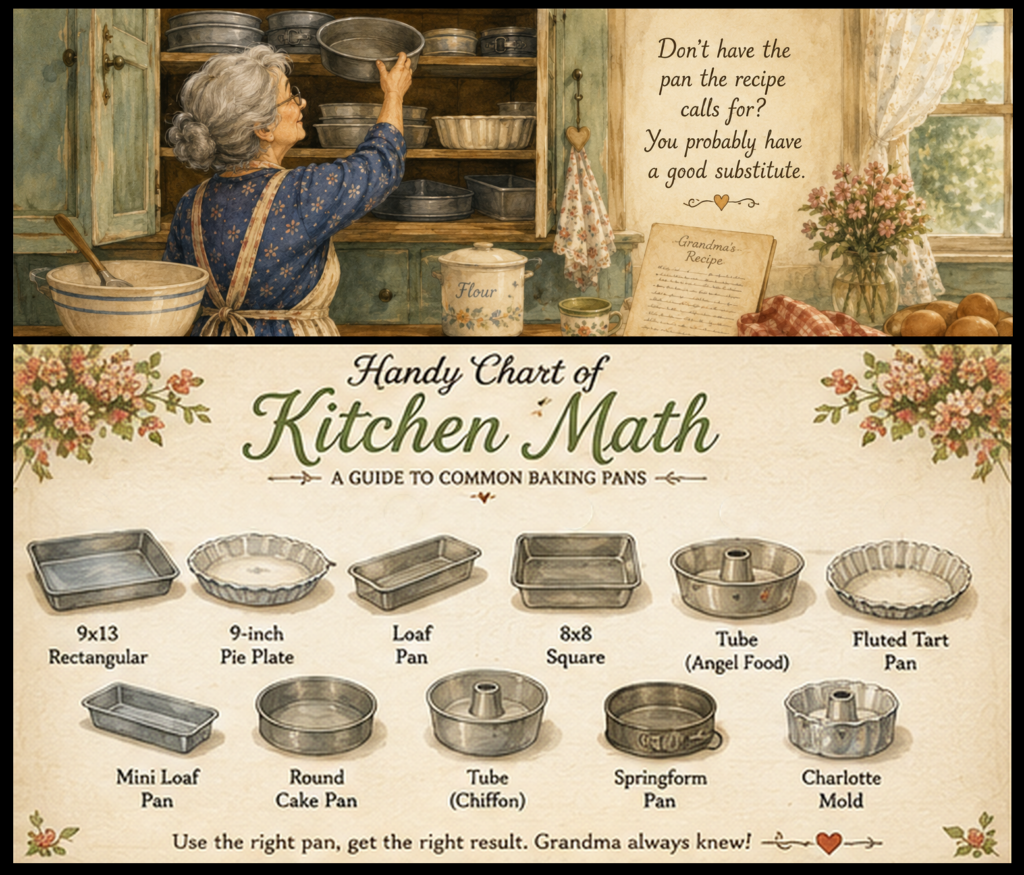
The old-fashioned chart you provided was designed to help cooks match the pan they had with the size called for in a recipe.
One important thing to remember
The measurements and capacities in the original chart are approximate. Different manufacturers make pans with slightly different depths and shapes, so two pans that have the same advertised dimensions may not hold exactly the same amount.
When substituting pans, the amount of batter and the depth of the batter are more important than simply matching the shape.
4-Cup Baking Dish
These smaller pans work well for
- 9-inch pie plate
- 8 × 1¼-inch round layer cake pan
- Approximately 7⅜ × 3⅝ × 2¼-inch loaf pan
- Small cakes
- Pies and tarts
- Small casseroles
- Quick breads
- Smaller batches of baked desserts
Grandma’s kitchen trick
If you don’t have a small casserole dish, don’t automatically assume the recipe can’t be made. A pie plate or appropriately sized cake pan may work just fine.
6-Cup Baking Dish
- 8- or 9 × 1½-inch layer cake pan
- 10-inch pie plate
- Approximately 8½ × 3⅝ × 2⅝-inch loaf pan
- Medium-sized cakes
- Pies
- Breads
- Smaller casseroles
- Desserts
A deeper loaf pan will produce a taller, narrower result than a wide, shallow pan containing the same amount of batter.
8-Cup Baking Dish
Think brownies and bars
- 8 × 8 × 2-inch square pan
- 11 × 7 × 1½-inch baking pan
- Approximately 9 × 5 × 3-inch loaf pan
- Brownies
- Dessert bars
- Small casseroles
- Cornbread
- Coffee cakes
- The 11 × 7-inch pan spreads
The 11 × 7-inch pan spreads the same general amount of batter over a larger surface, so the finished food will generally be shallower.
10-Cup Baking Dish
- 9 × 9 × 2-inch square pan
- 11¾ × 7½ × 1¾-inch baking pan
- 15 × 10 × 1-inch jelly-roll pan
Deep pan → thicker/taller baked good
Shallow pan → thinner baked good
Depth affects baking time too. A thick cake usually needs a little longer in the oven, and a thin one may be done sooner. Instead of relying only on the time in the recipe, start checking a bit early and watch for signs that it’s done, like a toothpick coming out clean or the top springing back when lightly pressed.
12-Cup Baking Dish — and Larger
Think brownies and bars
- Approximately 12 cups 13½ × 8½ × 2-inch glass baking pan
- Approximately 15 cups 13 × 9 × 2-inch metal baking pan
- Approximately 19 cups 14 × 10½ × 2½-inch roasting pan
- Large casseroles
- Family-size baked dishes
- Holiday cooking
- Roasts
- Large desserts
- Recipes intended to feed a crowd
Don’t assume a recipe calling for a “9 × 13 pan” will behave identically in every 9 × 13 pan. Material, actual interior dimensions, and depth can vary.
Glass and metal also heat differently, so baking time and temperature may need attention when switching between them.
Specialty Baking Pans
Many of these pans aren’t used every day anymore. Tube pans have a hollow center that allows heat to reach the middle of a tall cake.
- 7½ × 3-inch Bundt-style tube 6 cups
- 9 × 3½-inch fancy tube 9 cups
- 9 × 3½-inch angel cake pan 12 cups
- 10 × 3¾-inch Bundt/Crownburst 12 cups
- 9 × 3½-inch fancy tube 12 cups
- 10 × 4-inch Kugelhopf/fancy tube 16 cups
- 10 × 4-inch angel cake pan 18 cups
- Examples include:
- Angel food cake
- Chiffon cake
- Pound cake
- Bundt-style cakes
Why tube pans are different The center tube helps heat reach the middle of a deep cake. They’re especially useful for cakes that need to rise high and bake evenly.
Melon Mold
7 × 5½ × 4-inch mold — approximately 6 cups
This is a specialty mold designed for shaped desserts. It’s a great example of the kind of bake-ware Grandma might have had tucked away in the cupboard for a special occasion.
Springform Pans
7 × 5½ × 4-inch mold — approximately 6 cups
This is a specialty mold designed for shaped desserts. It’s a great example of the kind of bake-ware Grandma might have had tucked away in the cupboard for a special occasion.
- 8 × 3-inch springform — approximately 12 cups
- 9 × 3-inch springform — approximately 16 cups
- Common uses
- Cheesecake
- Delicate cakes
- Tarts
- Desserts with fragile crusts
- 8½ × 2¼-inch ring mold — approximately 4½ cups
- 9¼ × 2¾-inch ring mold — approximately 8 cups
- Ring cakes
- Molded desserts
- Decorative gelatin desserts
- Certain chilled desserts
A springform pan has a removable side, making it especially useful when you don’t want to turn the finished dessert upside down to remove it.
Ring Molds
7 × 5½ × 4-inch mold — approximately 6 cups
Ring molds create a hole in the center of the dessert without necessarily having the tall sides associated with a traditional tube pan.
- 8½ × 2¼-inch ring mold — approximately 4½ cups
- 9¼ × 2¾-inch ring mold — approximately 8 cups
- Ring cakes
- Molded desserts
- Decorative gelatin desserts
- Certain chilled desserts
Charlotte Mold
6 × 4¼-inch — approximately 7½ cups
A Charlotte mold is designed for molded desserts and is traditionally associated with charlottes and other elegant layered or molded desserts.
It is another piece of bakeware that you don’t see in every modern kitchen—but that’s part of what makes this old chart so interesting.
Brioche Pan
9½ × 3¾-inch — approximately 8 cups
The fluted brioche pan gives bread its distinctive decorative shape. It can be used for:
- Brioche
- Rich yeast breads
- Decorative breads
- Other specialty baked goods
The Most Important Rule: Don’t Overfill Your Pan
This is probably the most useful piece of advice to pull out of the old chart.
When changing pans, don’t fill the replacement pan to the very top.
For many cakes and baked goods, leaving room for the batter to rise is essential. A common rule of thumb is to fill a cake pan around ½ to ⅔ full, depending on the particular recipe.
If you’re uncertain, it’s better to have a little batter left over than to have batter overflowing into your oven.
How to Substitute One Pan for Another
- Look at the capacity first.
If the recipe calls for a 6-cup pan, try to find another pan that holds roughly 6 cups. - Consider the shape.
A round pan, square pan, loaf pan, and shallow rectangular pan will produce different shapes and depths even if they hold similar amounts. - Consider the depth.
A smaller-diameter, deeper pan produces a taller result.
A wider, shallower pan produces a thinner result. - Watch the baking time.
Changing the pan changes the depth of the batter, which can change how quickly it cooks.
Start checking for doneness earlier when using a significantly shallower pan. - Don’t forget the material.
Glass, dark metal, shiny metal, ceramic, and other materials can bake differently.
If you’re making a substitution, watch the food—not just the clock.